HKUST(GZ) Invites Foreign Talents for NSFC Fund Applications
Release Date:
2024-03-04 14:05:21
Update Date:
2024-03-04 14:05:23
Basic Information
The Hong Kong University of Science and Technology (Guangzhou) invites foreign scholars to apply through the university for support from the National Natural Science Foundation of China (NSFC). This initiative aims to enhance research opportunities and career development for researchers at various academic stages. Application channels are now open, below is a brief description of the programs available for foreign scholars.
I. Research Fund for International Scientists in 2024
1. Types of Grants
The RFIS consists of three sub-types:
(1) The Research Fund for International Young Scientists (RFIS-I)
(2) The Research Fund for International Excellent Young Scientists (RFIS-II)
(3) The Research Fund for International Senior Scientists (RFIS-III)
2. Funding Areas
The funding areas include: Mathematical and Physical Sciences (A), Chemical Sciences (B), Life Sciences (C), Earth Sciences (D), Engineering and Material Sciences (E), Information Sciences (F), Management Sciences (G), Health Sciences (H), and Interdisciplinary Sciences (T).
3. Funding Amount
(1) For the RFIS-I, the direct cost is 200,000 RMB per year (per project) .
(2) For the RFIS-II, the direct cost is 400,000 RMB per year (per project) .
(3) For the RFIS-III, the direct cost is 800,000 RMB per year (per project) .
4. Project Duration
Applicants can apply for either one-year or two-year RFIS project. The one-year project is expected to last from January 1, 2025 to December 31, 2025, while the two year project is expected to last from January 1, 2025 to December 31, 2026.5. EligibilityThe RFIS is aimed at international scientists who are ready to work at Chinese host institutions. The host institution must be based in China’s mainland and have registered at NSFC. Specific requirements for each sub-type of the RFIS are as follows:
1. RFIS-I
(1) Doctoral degree obtained within the past 6 years (Doctoral degree was obtained after January 1, 2018);
(2) Experience of conducting basic research or postdoctoral research;
(3) Commitment to work for no less than 9 months each year (calendar year) at the host institution during the implementation of the project;
(4) Compliance with Chinese laws and NSFC’s relevant rules and regulations while conducting research in China.
2. RFIS-II
(1) Doctoral degree completed within the past 15 year (Doctoral degree was obtained after January 1, 2009);
(2) Senior academic title;
(3) Experience of conducting basic research projects as Principal Investigator (PI);
(4) Commitment to work for no less than 9 months each year (calendar year) at the host institution during the implementation of the project;
(5) Compliance with Chinese laws and NSFC’s relevant rules and regulations while conducting research in China.
3. RFIS-III
(1) Senior academic title;
(2) Outstanding academic achievements and significant international influence;
(3) Commitment to work for no less than 9 months per year (calendar year) at the host institution during the implementation of the project;
(4) Compliance with Chinese laws and NSFC’s relevant rules and regulations while conducting research in China.
Please refer to the official websites for details:
https://www.nsfc.gov.cn/english/site_1/international/D5/2024/01-26/355.html
II. International Collaboration Fund for Creative Research Teams in 2024
1. Funding Areas
The funding areas include: Mathematical and Physical Sciences (A), Chemical Sciences (B), Life Sciences (C), Earth Sciences (D), Engineering and Material Sciences (E), Information Sciences (F), Management Sciences (G), Health Sciences (H), and Interdisciplinary Sciences (T).
2. Project Duration
Projects are expected to start on January 1, 2025 and end on December 31, 2027 with a duration of three years.
3. Funding Amount
The grant provides a total direct cost of 6 million RMB per project and a total indirect cost of 1.2 million RMB per project. For projects of Mathematical Sciences and Management Sciences, the direct cost is 4.8 million RMB per project and indirect cost is 1.2 million RMB per project.
4. Eligibility
(1) The applicant, as the PI of the Collaborative Creative Research Team, shall meet the following requirements:
a. Foreign citizenship and a senior academic title;
b. Outstanding academic achievements and significant international influence, and ability to construct and lead a research team to conduct creative research in China’s mainland;
c. Commitment to work for no less than 6 months per year (calendar year) at the host institution during the implementation of the project;
d. The Agreement to Support the Application of ICFCRT shall be signed between the applicant and the host institution (If the applicant has a full-time position abroad at the application stage, the foreign employer institution should be informed).
(2) Participants as backbone researchers of the Collaborative Creative Research Team, regardless of nationalities, shall hold senior academic titles or doctoral degrees.
(3) No more than 4 backbone researchers and 2 participating institutions in each project.
(4) Compliance with Chinese laws and NSFC’s relevant rules and regulations while conducting research in China.
Please refer to the official websites for details:
https://www.nsfc.gov.cn/english/site_1/international/D6/2024/01-26/356.html
Contact Information:
Research Department: WANG Yanfei
yanfeiwang@hkust-gz.edu.cn
Talent Service Department: WU Jiacheng
jiachengwu@hkust-gz.edu.cn
University Profile
Formally established in June 2022, the Hong Kong University of Science and Technology (Guangzhou) (HKUST(GZ)) is a cooperatively-run university between the Chinese mainland and the Hong Kong Special Administrative Region. HKUST(GZ) has obtained approval from the Ministry of Education (MoE) and become the first legally-independent educational institution co-established by the Mainland and Hong Kong since the announcement and implementation of the “Outline Development Plan for the Guangdong-Hong Kong-Macao Greater Bay Area” and the “Overall Plan for Deepening Globally Oriented Comprehensive Co-operation amongst Guangdong, Hong Kong and Macao in Nansha of Guangzhou”. With a spirit of pioneering innovation, HKUST(GZ) charts new territories in cross-disciplinary education and explores new frontiers in pedagogies, aiming to serve as a role model of the mainland-Hong Kong integrated educational development and become a world-famous high-level university, endeavoring to nurture future-oriented, high-level and innovative talents.
Location
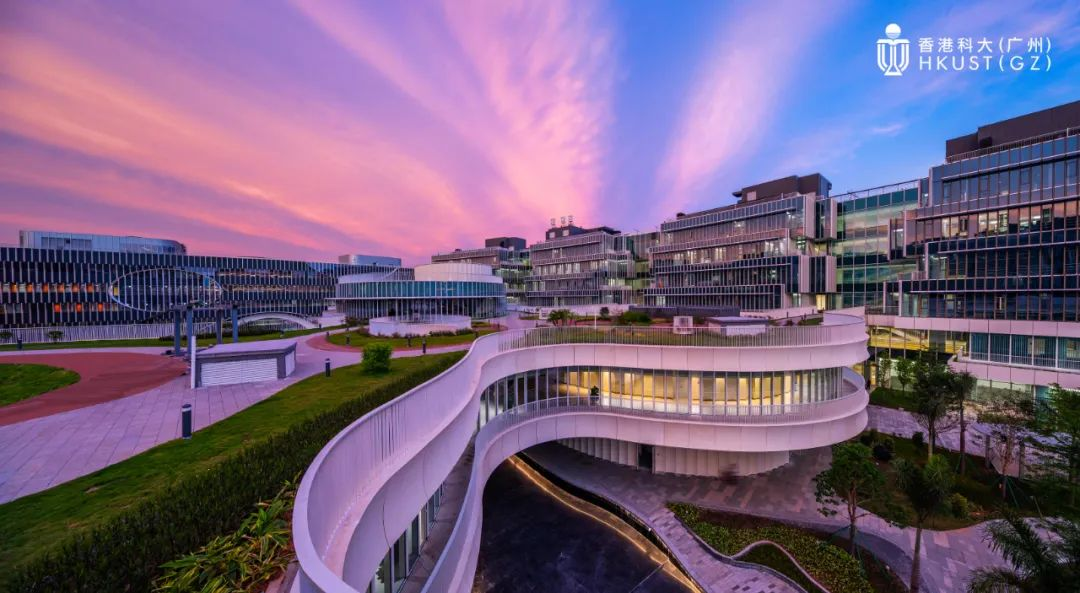
HKUST(GZ) is located in Nansha District, the geographical center of the Guangdong-Hong Kong-Macao Greater Bay Area and one of the "dual cores" of Guangzhou. The campus covers an area of about 1,669 mu (111.3 hectares) and is divided into two construction phases. The floorage of the first phase is about 636,000 square meters (63.6 hectares), which has been officially put into use. The university is actively advancing the second phase of development, with a projected completion date of 2026. Following international standards and inheriting the concept of HKUST's Sustainable Smart Campus, HKUST(GZ) aims to integrate nature and architecture, striving to create a Smart Green Campus.
In order to foster true and meaningful collaboration between the two campuses, the Guangzhou campus is conveniently adjacent to the Qingsheng station on the high-speed Guangzhou-Shenzhen-Hong Kong Express Rail Link. It takes just 40 minutes to travel there from the Hong Kong West Kowloon railway station.
Campus View
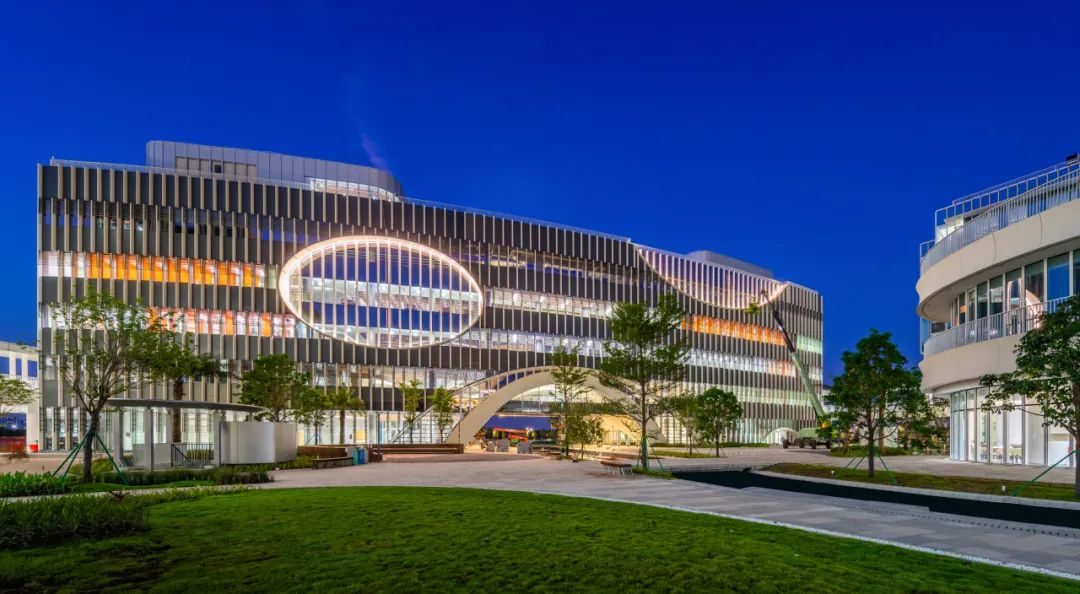
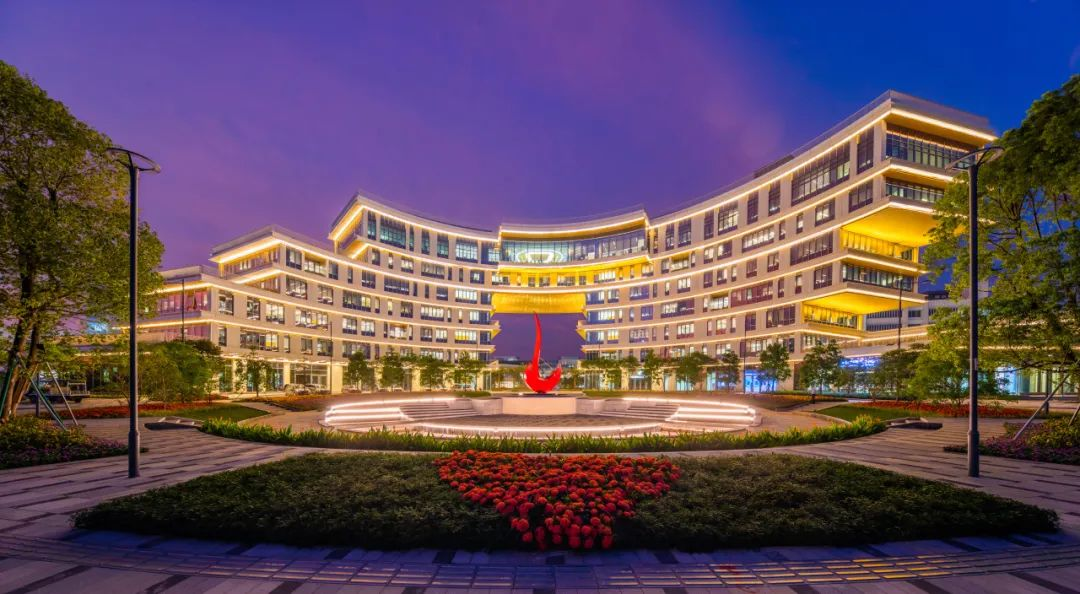
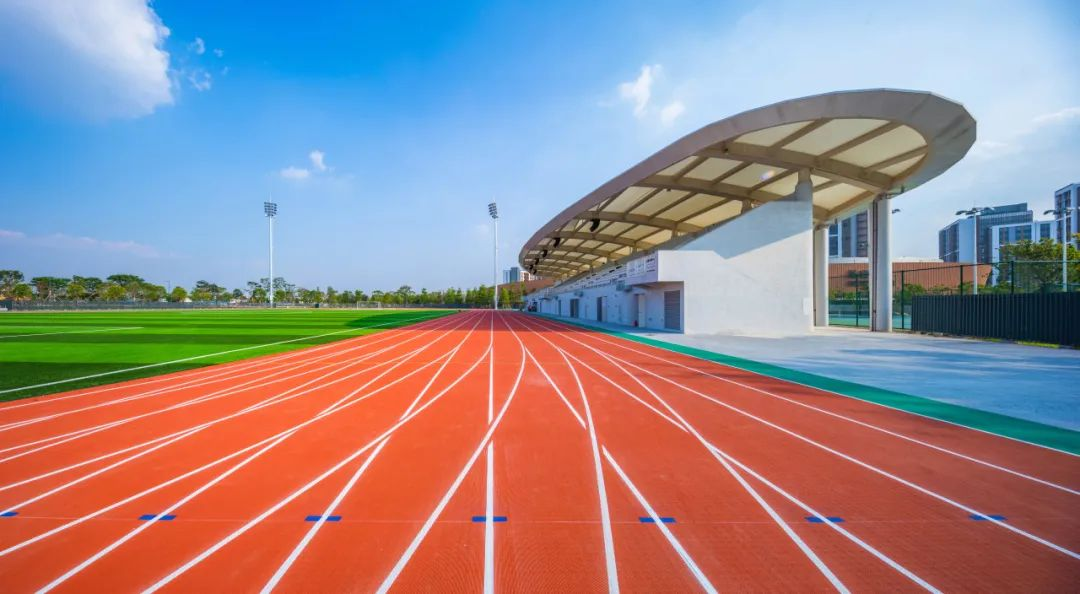
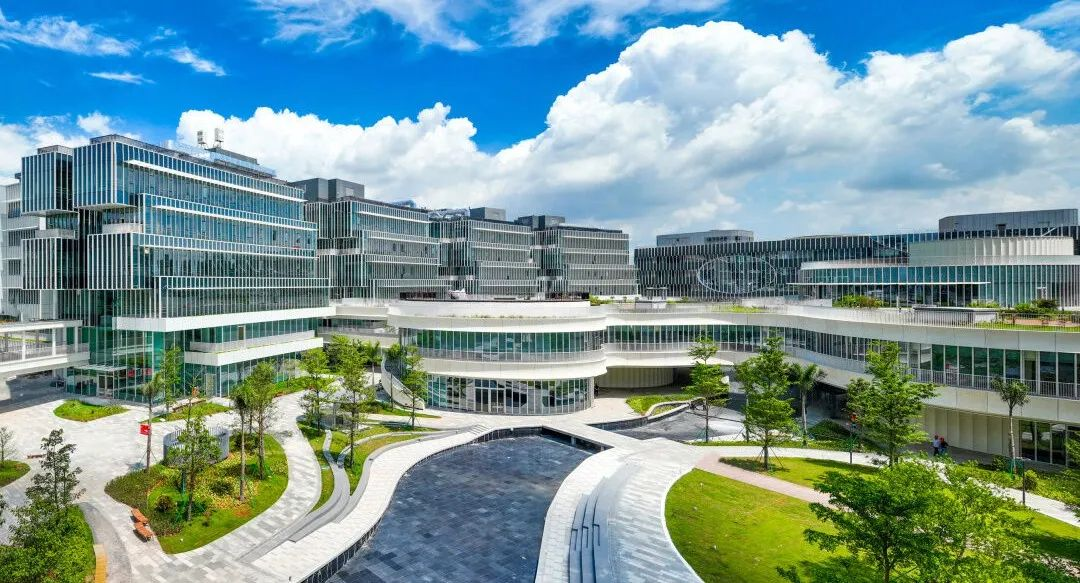
Academic Structure
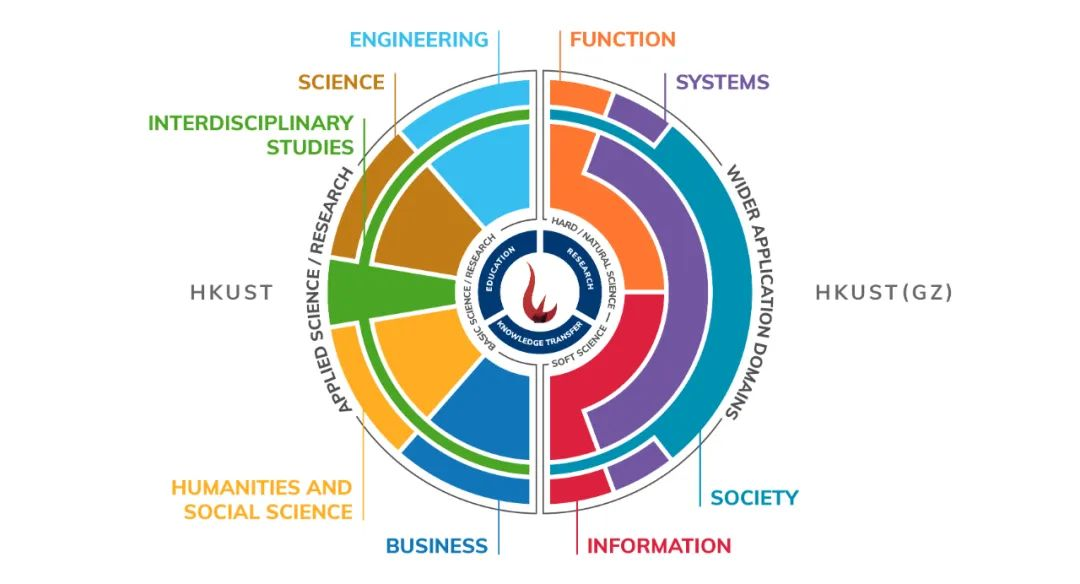
The traditional academic structure of HKUST and the hub structure featuring integrated disciplines at HKUST(GZ) are interrelated, developed in a complementary manner, and mutually beneficial. The faculty, degrees granting, and courses at both campuses are maintained at the same level to uphold the consistency of the university brand. The two campuses establish Cross-Campus Faculty Affiliate, open courses to each other, jointly cultivate students, share experimental facilities and equipment, and collaborate on research projects. Through enhancing efficiency and complementarity in academic, administrative, and knowledge transfer aspects, the development of both campuses is stimulated, cultivating interdisciplinary and diversified high-end innovative talents that meet the needs of the country and adapt to the future social development in the Guangdong-Hong Kong-Macao Greater Bay Area.
HKUST(GZ) comprises four Hubs, namely Function Hub, Information Hub, Systems Hub, Society Hub and 16 master and doctoral programs. In the first year of undergraduate education, HKUST(GZ) offers three majors including Artificial Intelligence, Data Science and Big Data Technology and Smart Manufacturing, and will gradually set up other undergraduate majors.
Talent Cultivation
HKUST(GZ) is under the supervision of the People's Government of Guangdong Province. The university offers undergraduate, master's, and doctoral education. Currently, there are nearly 1,800 students, and the future enrollment is expected to reach approximately 10,000, including 4,000 undergraduates and 6,000 postgraduates. Following the national unified enrollment policy, HKUST(GZ) admits undergraduate students and, in accordance with the graduation requirements of both campuses, awards the graduation certificate of HKUST(GZ) and bachelor's degree certificate of HKUST. The university also launch master’s and doctoral degree program in accordance with relevant regulations and graduation requirements, awarding master's and doctoral degree certificates of HKUST.
The university adheres to a "student-centered" approach and continuously explores interdisciplinary education paradigm. In undergraduate cultivation, it initiates “broad undergraduate admission" and adopts a residential college system, uses modularized courses, and offers direct admission to Ph.D. programs. In terms of postgraduate cultivation, the university has launched the Red Bird MPhil Program program and practices the "hub” concept featuring integrated discipline. Through launching team projects guided by academic supervisors, project mentors, and industry mentors, the program aims to cultivate "top talents and future leaders in academia and industry."
The university is committed to fostering and enhancing students' hands-on abilities. It has established the Red Bird Maker Space (RBMS) to provide high-standard facilities, including Machining and Fabrication Workshop, Carpentry and 3D Modeling Workshop, Precision Manufacturing and Measurement Lab, Materials Preparation Lab, Electronic and Electrical Lab, laying a solid foundation for students' development in innovation and entrepreneurship.
Academic Talents
The university currently has more than 200 substantiation track faculty (STF), all holding doctoral degrees, and having studied or worked in research and teaching at world-renowned institutions. This includes 3 full-time academicians from developed countries and regions, 13 fellows of renowned international academic institutions, 41 individuals who have been selected as national-level talents, and 34 professors who have been listed among the top 2% scientists. Within 5 years, the number of STF at the university is expected to reach 500.
Research Platform
The Central Research Facilities (CRFs) in HKUST(GZ) do not overlap with those in HKUST in terms of major equipment. While open to other universities and industry, the CRFs serve as technology platforms supporting researchers in both universities, fostering a conducive environment for collaboration and engagement with industry in the Greater Bay Area and worldwide. Currently, HKUST(GZ) has 15 Central Research Facilities and has established 14 Theme-based Labs.

Since its establishment, HKUST(GZ) has been approved for 1 Guangdong Provincial Key Laboratory, 1 Provincial Research Base, and 6 Guangzhou Key Laboratories, including:
Provincial Key Laboratory:
Guangdong Provincial Key Laboratory of Integrated Communication, Sensing and Computation for Ubiquitous Internet of Things
(“广东省通感算交叉融合泛在物联网重点实验室”)
Provincial Humanities and Social Sciences Key Research Base:
Artificial Intelligence Research and Learning Base of Urban Culture
(“人工智能城市文化传播基地”)
Guangzhou Key Laboratory:
Guangzhou Municipal Key Laboratory of Materials Informatics
(“广州市材料信息学重点实验室”)
Guangzhou Big Data Intelligence Key Laboratory
(“广州市大数据智能重点实验室”)
Guangzhou EDA Key Laboratory
(“广州市集成电路设计工具(EDA)重点实验室”)
Guangzhou Key Laboratory of Brain and Intelligence
(“广州市脑与智能重点实验室”)
Guangzhou Key Laboratory of Seamless Connectivity and Connected Intelligence
(“广州市全域互连与网联智能重点实验室”)
Guangzhou Key Laboratory of Interdisciplinary and Frontier AI
(“广州市人工智能前沿交叉科学重点实验室”)
Research Projects
Since the establishment of the university, HKUST(GZ) has been awarded 175 government-sponsored research projects in total, among which 73 projects are at the national level, 27 are at the provincial level and 75 are at the municipal level.
Knowledge Transfer
Innovation is in the DNA of HKUST(GZ). HKUST(GZ) has established the Entrepreneurship Center (EC) to provide support for campus-based entrepreneurial projects and foster a thriving entrepreneurial ecosystem. HKUST(GZ) has actively engaged with over a thousand companies for industry-academia research collaboration. It has signed cooperation agreements with more than 100 leading enterprises and renowned research institutions, establishing joint laboratories with nearly 10 industry leaders.